Showing posts with label Lazy Sundays. Show all posts

Tuesday, September 26, 2023

Projectile Vomit

These days, social media can seem a lot like that iconic scene from the original first Star Wars movie where our heroes are caught in the trash compacting room. In essence, we are all swimming in garbage, desperately trying to keep ourselves from being crushed by garbage, or perhaps we have just enough time to escape...

I am referring specifically to X, the site formerly known as Twitter, and what it has become of it since the Muskrat took over nearly a year ago. Like many people, I have remained out of a morbid sense of curiosity to see just how bad things could get. Well, if you recognize my Star Wars analogy, then we might be at the point in the scene where the walls are closing in but C-3PO wants Luke to listen to his misadventures with R2-D2 evading storm troopers. In other words, democracy has only a slim chance of survival while we are fretting over foolishness. 

Every now and then, since I won't pay for a blue check, I say something on that platform that gets noticed and I have to admit, it gives me a thrill to think that for a brief, shining moment, I'm not just some random person shouting into the cyberverse. That was, until last Sunday when I spoke out against the tirade posted by Keith Olbermann prior to the debut of Kristen Welker as the new moderator of Meet the Press. From that one tweet came a variety of responses, the kind where people unwittingly tell on themselves, particularly those who claim to be allies.

To recap, I was scrolling Twitter early Sunday morning on the 17th. I saw a series of tweets posted by the aforementioned Olbermann, whom I follow because I used to be a fan of his now-defunct show, Countdown, when it aired nightly on MSNBC in the early aughts. Back then I looked forward to his bombastic and hyperbolic rants against the Bush Administration, especially his nightly Worst Person in the World segment (framed by Bach's Toccata and Fugue in D Minor). His most recent incarnation in media is as host of a podcast of the same name, which I assume follows the same format of ranting and raving about whatever annoys him on any given day.

Now, it is significant to highlight how this is Olbermann's latest incarnation having had a long broadcast career that has involved stints at ESPN, FOX Sports, MSNBC, Current TV, and TBS. At the conclusion of these high-profile media gigs, Olbermann has often left in a blaze of inglorious self-immolating and obnoxious defiance (and I'm using all of these SAT words in homage to this brilliant SNL skit). In simpler terms, he's a blowhard who gleefully juggles lit matches that burn everything and everyone in his wake. We all know people like him, brilliant yet dangerously toxic, so while I found his schtick entertaining 20 years ago, hubris isn't what one would call an endearing personal quality.

Yet, I still follow him, and even after last week, I haven't gone so far as to mute or block him because as long as we're all still using Musky's platform, we're all just wading in a galactic trash heap on a doomed Death Star. I know that KO's rhetoric is over the top, and there are instances when he can be: (a) hypocritical; (b) sexist; and (c) wrong. He's now leaning into stereotypical podcast bro territory, while I'm another long-winded mommy blogger (so make of those caricatures whatever you want). Once upon a time, people like us were on the same side, shouting into the void.

To be clear, my issue with Olbermann's tirade was that of all people who have been extended grace throughout their career (and he's been at this for 30+ years), he ought to be willing to do the same. He could have let the interview air before denouncing Welker as a failure on her first day on the job. If you read any of his tweets from last Sunday (and the week prior), he had a LOT to say. FWIW, I have an opinion on that interview which I most certainly plan to express without conducting a Salem witch-level trial and execution. Read on.

I hit send on my tweet and gathered my things. You see, those of us who live in the real world have more important isht to do than scroll Twitter all day. I headed over to my parents' house, so that meant that I wouldn't be at church that morning. Thus, I had time to actually watch the interview in real time to judge for myself whether it was as bad as it appeared from the pre-released clips circulating on social media. In the meantime, my tweet stirred up a little dust, beginning with some lady demanding to know who I was.
Now here's where this all got interesting because I could have ignored her and kept living my best life, but I was feeling froggy and decided that her snarky so-who-do-you-think-you-are deserved a clapback. Because I think that it is rather ironic to be confronted by a fellow unverified "nobody" on Twitter as if that question is supposed to make me feel ashamed for daring to call out someone's bullshit. I am who I am, I replied, to which this KO groupie responded that I was probably just some desperate clout-chaser. At that point, I got curious, checked her profile, and saw that we were ideologically aligned. In the real world, one might even say that we would be protest allies, so I decided to end the exchange with a go forth and #BeBest. 

I went about the rest of my day and came back to Twitter several hours later. There were a few more responses to my tweet, some aghast that I had deigned to challenge the wisdom that had erupted from Mt. Olbermann. One twit hit back at me three times with commentary about Welker's inadequacies for the role that went from 0 to sexist/racist in 60 characters. I stretched my Twitter fingers, took a deep sigh, and calmly replied that I had never mentioned Welker's race or gender in my original tweet. Because the point of my tweet to Olbermann had been to point out the hypocrisy that he who had been given numerous chances to screw up and piss folks off throughout his career would come down so hard against someone barely into her first day on the job. 

Nevertheless, they persisted in suggesting that I was making excuses for Welker because she was a Black woman, so again, I reiterated that I had not mentioned race or gender, nor had I defended Welker. I went to bed and woke up to more of their nonsense, so as I had done with the first KO groupie, I peeped this person's profile and determined that they were probably another so-called ally. Yeah, go feed your cats and #BeBest.

All week, what nagged at me about these petty skirmishes was how these attacks were coming from the same pink pussy hat, safety pin, middle management, pumpkin spice coffee club folks who walk their dogs past my house but don't speak. We're allegedly on the same side, until I dare to express an opinion that goes against their community standards. Suddenly, they can see my nearly 6-foot-tall frame to clearly glean enough of what I said to tell me what they thought I meant to say.

No bish, you said that. 

However, since you raised the topic of Welker's race and gender and her ability to perform the job, let's discuss. Because y'all are good for propping women of color up for failure by setting impossible expectations and then demeaning their achievements as unearned. Kristen Welker is only the most recent example in a long line of Black women who find themselves targeted and undermined by so-called allies. For when else is it acceptable to denounce someone's job performance before they even show up for work?

Before I bring out any CVS receipts, I need to emphasize that these attacks don't just come from our suburban athleisure clad fellow keyboard warriors. Sometimes the loudest haters are the men who fight alongside us while secretly listening to and agreeing with Charlamagne tha God.

Days before the interview aired, I expressed skepticism whether this was the right move for Welker's maiden show. I was concerned that her bosses at NBC were using this interview to ensure high ratings for her debut, but also setting her up for the predictable fallout that followed. I believe that platforming Donald Trump is always irresponsible and dangerous, regardless of the newsworthiness of his position in the polls. I imagine that back in 1939 when TIME Magazine designated Adolph Hitler as its Man of the Year, they thought they were doing the world a service by publicizing his views because he too was a compelling public figure. The difference as I see it is multifaceted--not only did we learn our lesson by legitimizing Hitler, but we should have known better than to underestimate Trump's appeal after 2016. We now know what manner of destruction he can instigate after January 6. He could have held a rally to broadcast his lies and spew the same poison, so why put a Black woman in the position of facilitating our demise?

I watched the interview (twice) and was dismayed that the edit we saw did not put Trump on the defense; instead, it allowed him to prate on unchallenged and unrestrained. He has posted many of the same fabulist boasts and dubious claims on his Truth Social without the imprimatur of NBC News. That Welker showed deference to the office he previously held didn't bother me (because every former President is addressed as 'Mr. President') as much as there appeared to be some manner of deference to him personally as well. The fact that I had to go look for the full fact-checked edit and potentially sit through that booshay a third time annoys me. It is unlikely that any of that previously unaired footage will get replayed or reposted as a rebuttal to his mendacity. Furthermore, it shouldn't be our responsibility to discern whether he was lying when the entire point of interviewing him should have been for us to see in real time how much of a prevaricating huckster he is. 

Yet, I'm clear that the network's goal was achieved--Welker's debut drew more viewers than her competitors. Whether that will continue is yet to be determined, but the gamble paid off and folks watched either to affirm their pre-emptive biases or like me out of curiosity. That doesn't mean she deserves any high fives, and I'm not dapping her up because that first Sunday was a stunt. The real work of retaining viewers and proving her chops starts this week.

Notice how I did not argue that she deserves a pass because she happens to be the first woman of color in the Sunday morning news anchor chair. Nope, I'm saying that she deserves the opportunity to prove that she can do this job the same as the others who preceded her. David Gregory served as the moderator for six miserable years before the job went to Chuck Todd who dragged us through nine more. To suggest that Welker is a failure as compared to her predecessors after one show is...I need to think of a more appropriate word than ridiculous. Furthermore, to argue that she deserves the same chance to sink or swim isn't making an excuse for her race or gender; it is consistent with what has been the pattern and practice prior to her assuming the job.

And because it was discussed on Twitter, Welker is qualified for the job. So are any number of other journalists who may have been considered. To assume that she only got the job because of her race and gender, but not on the merit of the work she had done to get to this point is an affront to EVERY woman of color in journalism. To say that she is qualified is not the same as saying she is the right fit to host this show, but she deserves the chance to convince us. Or not.

Which brings me back to Olbermann and his groupies who seem to think that his past role as a voice for our left-leaning frustrations against the system were supposed to buy him perpetual loyalty. Umm, no he can catch these Twitter fingers just like anybody else. He's hardly on the level of elder news-statesmen Dan Rather or Ted Koppel--he's a former sports anchor with strongly held political opinions and a perpetual axe to grind. If he's baying at the moon in the wee hours of a Sunday morning about someone else's job performance at the network where he used to work (and to which he was willing to return as recently as a year ago)...trust I'm not the one who is desperate for attention.
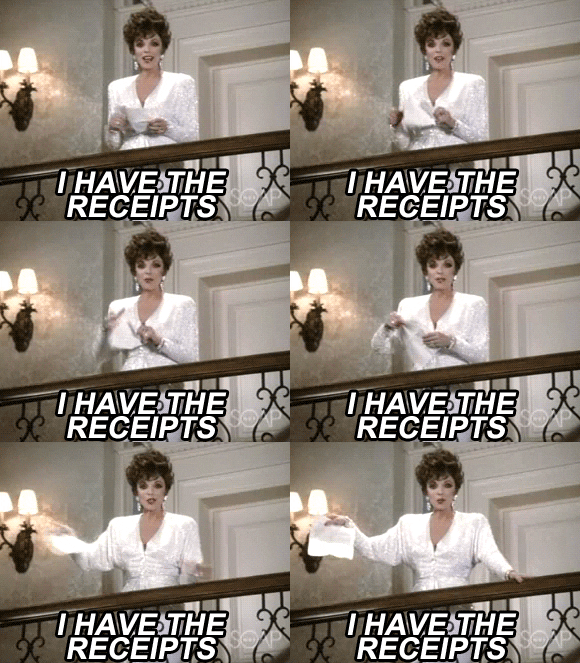
Finally, off the top of my head, I said I could produce receipts on the biases shown against Black women in visible positions, so let's start off with none other than Vice President Kamala Harris and the calls to replace her as Biden's running mate. I took note of how my Spelman sister Roz Brewer, the only Black woman serving as a CEO in the Fortune 500 until last month, was ousted from that position after less than two years. If we thought they had run out of tiki torches for the mob that organized to keep Pulitzer Prize-winning journalist Nikole Hannah-Jones from receiving honorary tenure at her alma mater, they had sufficiently re-stocked to prevent the appointment of journalist Kathleen McElroy at Texas A&M University. In Georgia, the legislature passed a law intended to reign in prosecutors who pursue criminal justice reform with designs to test it out against DA Fani Willis just as she is about to try her biggest case. 

But those are just coincidences, right? According to that second twitter heckler, this is just another day of playing BINGO for me, because I can't imagine a world wherein a Black woman might be judged fairly on her job performance and come up short. Okay, cat lady, I can produce more than a paragraph of receipts: I wrote this and this, and this when y'all were traumatized by a Black actress being cast as the heroine in a children's movie. You're probably still bitter about your pancake mix. So yeah, it is exhausting because sexism with a chaser of racism feels like a relentless deluge when allyship is so transactional and performative.

I said what I said, and so did Maya Angelou. I didn't accuse Olbermann of bias; I called him a hypocrite. If you insist on reading more into what I twote, comprehension is just one of your problems.

Saturday, May 27, 2023

Shades of Purple

Come gather 'round children, because your Busy Black Mother wants to tell you all a story about a book and ALL of the trouble it has caused ever since it was published back when she was in elementary school in the early 80s. It has been quite a while since she "read" it (almost 40 years), but from what she can recall, it tells a rather polarizing story about a woman who survives abuse. In fact, there are several women in the story who survive various forms of abuse. This book won several prestigious awards for its author, became a critically acclaimed cult classic film, and was adapted as a Broadway musical for the stage that will be re-released in a new film adaptation later this year.

The Color Purple ("TCP") is a story that deeply offends certain groups of people. Having been around all of these years to witness its various iterations and adaptations, I can speak both directly and indirectly to aspects of the controversy. The book has been banned for its sexual explicitness which some find to be too mature for impressionable readers. The book and film have been criticized for depicting negative images of men as abusive. The book, film, and play provide cultural references and timeless quotes, much like The Godfather, that are appropriate to offer in almost any situation. Your perspective in favor or in opposition to the story depends on how you self-identify: (1) as a Florida Mom who dislikes Oprah Winfrey's poetry; (2) some sanctimonious woman named Karen who only heard about the sex scenes in the book; (3) somebody's Black Grandfather or elder Uncle who saw the movie once in the 1980s; (4) some young man who may have seen the movie a couple of times on BET, but his impressions have been shaped by what his Grandfather or Uncle said about it at the barbershop; or (5) a Black woman.

Let's quickly dispatch with the first two categories because they are in fact, the same person. It doesn't really matter what her real name is if she hasn't read the book but still insists on having it banned. I doubt that she's even taken the time to skim an online summary, because if she had, she would have a better response to its sexual content other than to clutch her pearls. But then again, this same woman raises objections to most books that contain sexual references because she only had sex to procreate. Now that she has her 2.5 children, she can channel that energy into other hobbies such as riding her Peloton, micro-managing, and filing complaints against her neighbors with the home-owners association for petty infractions. 

The targeted audience for this piece is the latter three categories of Black people. I am making an assumption that members of other communities aren't having these kinds of deep philosophical discussions about TCP, but if I'm wrong, feel free to associate with the group that makes the most sense. For example, if you happen to be a woman named Karen who read the book, likes/loves the movie and/or the play, then you are welcome to sit with like-minded Black women. Ditto if you are a Black man who knows that half of what you grew up hearing in the barbershop is unlotioned foolishness, while the other half is just something that some dude heard and repeated because it made him sound smart. 

If you are still unsure, no worries because the goal here is enlightenment. However, if you already know which side you are on and it isn't with the Black women...

The Color Purple is a book about Black women written by a well-known Black woman writer named Alice Walker. The original movie is about Black women. The Broadway musical is about Black women. And I suspect that the new movie will also be about Black women. In none of these versions and iterations is The Color Purple about abusive Black men. Read that again because I said what I said: there are abusive Black men in TCP, but this story ain't about them!

TCP is a story about a Black woman in rural 1930s Georgia who is a victim of horrifying sexual, physical, and emotional abuse. In fact, several of the women in the story are victims of abuse. For Celie, the main character, this abuse begins when she is a teenager and continues until she finds the courage to leave her abuser, many years later. The same is true for other women in the story. Therefore, I must emphasize that TCP is a story about how a group of Black women survive, overcome, and ultimately heal from the abuse that has been inflicted on them.

Let's back up some 40 years to when the book was published. As I stated above, I was in elementary school and I don't remember much about the accolades in real time, but I do recall that it won the Pulitzer Prize and the National Book Award, and presumably that is why it was made into a movie. A few years later when I was in middle school, we heard that there were some steamy sex scenes contained therein, so like all curious pubescent teenagers, we needed to know. My Mom happened to be reading the book, so while I had access to it, I could not borrow it from her to read with my friends on our Metro summer commute.  Thus, someone else's older sibling must have borrowed for us, and for about a week, we "read" the book to find these scandalous sex scenes. 

Alas, the Karens were partially right in arguing that this content was too mature for young impressionable minds because most of us had no idea of what was going on. The most scandalous passages I remember reading contained nudity while bathing, self-discovery with a hand-held mirror, and two women sharing a kiss. None of the other themes made much of an impression because we were mostly scanning the book, not really reading it. I definitely did not get a full grasp of the lesbian relationship. The conclusion we all reached was that we would have to wait and see the movie to get a better understanding.

Fast forward to the release of the movie in 1985 which I did not get to see in the theater because it was rated R and I was twelve. It must have been years later before it came on television (and my family didn't have cable when I was growing up), so I was probably in high school when I finally saw it for the first time. And I had forgotten all about the alleged scandalous sex scenes (which were omitted, so there's that). 

Other specifics are also long-forgotten, but I do remember that my parents had opposing opinions about the movie. And it wasn't just a disagreement between them, because there was once a heated discussion about this film at a family gathering (no worries, no brown liquor was wasted), where sides were taken. My Dad, my Uncles, and some older male cousins expressed their opinion that the film was terrible; whereas, my Mom, my Aunts, and my older cousin who was in college were adamant that the menfolks were wrong. For my part, I did not express an opinion at that time because I was still in that gray area where kids were not allowed to participate grown folks' conversations. But I could listen. 

And I could reflect on what I heard. My Mom bought a copy of the movie on VHS so I could watch it as much as I wanted to decide for myself. Eventually, the movie became a Sunday afternoon staple on BET, but we'll revisit that a little later.

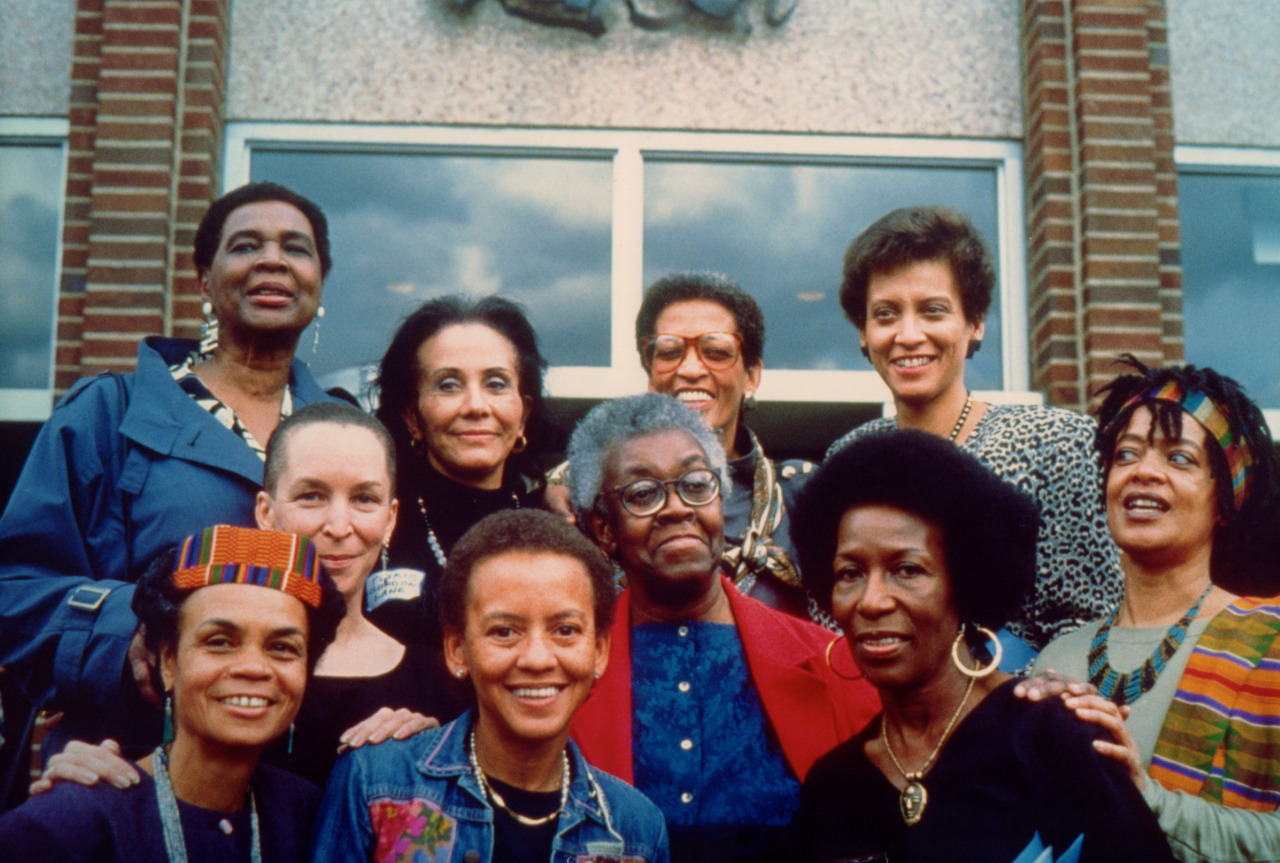
Instead, let's skip ahead to when I was at Spelman in the early 90s. As most of you know, I was an English major so my undergraduate degree was essentially a concentration in Black women's literature. The literary and artistic era of that time overlapped with a lot of great work written by Black women that received both critical and mainstream recognition. Most notably, Toni Morrison received the Nobel Prize in Literature, while other authors such as Walker, Gloria Naylor, Terry McMillan, and Spelman alumna Tina McElroy Ansa were on best-seller lists and having their books made into movies. With our charismatic Sister President and the fact that Spelman was a magnet for practically every prominent Black woman at the time, it meant that on any given day, I could see some brilliant Black writer whose work I just read walking around on campus. This iconic picture captures the vibe that permeated the air at that time.

Not pictured here was the ever-inspiring and brilliant Dr. Gloria Wade-Gayles, who was our resident Alice Walker scholar. She taught a mini-course on Walker that I had to sit in on once (don't remember why), where the students discussed her work and advocacy. It was a fascinating conversation that touched on a variety of topics, including Walker's reasons for leaving Spelman, her discovery of Zora Neale Hurston's grave, as well as the controversy that had accompanied TCP movie. Ironically, it was the first time that I witnessed a group of Black women offer criticism of TCP!

But don't get it twisted, these women were adamant that the shortcomings of the film were due to choices made by the filmmaker, the producers, and the actors, not the story as it was written. Certain characters were too cartoonish and some crucial elements of the book that were left out created unexplained gaps in the narrative. But at no point did any of these women argue that the male characters deserved to be judged with empathy, because at its heart, TCP was a story about the women.

The point of taking you on this side trip down memory lane was to set up what you must have assumed was the inevitable penultimate conflict that broke out in class between a group of my outspoken Spelman Sisters and some opinionated Morehouse Brothers. And you are half right, as there were several arguments that took place in Dr. Gayles' Images of Women in the Media class, except the argument I am recounting here was about another movie in another class.

Quite literally while I was thinking of some of the points I wanted to make in writing this piece on the new TCP, it was reported that rock icon Tina Turner had died. As the tributes to her (one forthcoming from me as well) poured in, one of the themes that kept getting repeated was how she was a survivor and feminist icon. And because those descriptions tend to trigger the denizens from Hotepistan armed with their pockets full of misogynoir pebbles, I knew it wouldn't take long before they would start throwing.

For it was during that same era when the Tina Turner biopic What's Love Got To Do With It (1993) was released, the summer before my return to Spelman for my senior year. During discussion in a class, some dude mentioned his frustration with the "constant" portrayals of Black men as abusive and made reference to TCP as part of what he saw as a "disturbing trend" in that direction. Record scratch...some sister stood up and asked incredulously (I'm embellishing): Brother, how do two movies released in a span of eight years point to a disturbing trend??? Are you serious? He countered that it wasn't just these two movies, but several works written by and about Black women that depicted Black men as evil, and then he offered this most incendiary shot across the bow: And half the women on this campus cheer that mess on because y'all hate Black men!

Now let me tell you, I don't know what happened to that dude, whether he made it back over to Morehouse with a full head of hair, or if he ever came back to class. Our inter-campus gender wars had been ongoing for years, so this wasn't anything that hadn't been heard or said before. Although I am pretty sure that this wasn't in Dr. Gayles' class, enough of us had been admonished by her in other courses to Claim Our Space, so the brother had no chance. He got ALL the smoke, with that original sister leading the charge. Since I cannot offer a play-by-play, I can tell you that the grand point that the sisters made that the brother ignored was this: These👏 Movies👏 Ain't👏 About👏 You👏 Boo👏

Like seriously, who goes to see a movie about Tina Turner's life with the expectation that Ike Turner ought to be depicted as a sympathetic yet misunderstood genius with no impulse control? Who reads a book written about an abused Black woman and expects that the story would urge readers to feel sorry for her abuser? Huh? In the canon of movies and books that had been written and championed by Black men, had there even been a fully-formed Black female character, someone who wasn't a two-dimensional cardboard cut-out simply placed in a scene to improve the optics? (Yep, here's looking at you Brother Spike.)

Furthermore, if Black women are telling stories about being abused, why is all this ire being aimed at the women for speaking up? Dead women can't speak for themselves, so the stories of survivors are what get told. Instead of being upset about the depictions of their abusers, perhaps get mad that there were/are men who subject women to that kind of treatment! We get it, not all men (just like not all white people, not all women named Karen, not all Christians, not all of any group, etc.), so if the accusation or depiction isn't reflective of who YOU are, then there is no need to be triggered or take it personally.

Literally, this is the same argument we've been having since before Al Gore invented the internet. Whether it takes place in analog or in these digital tweets, some of y'all refuse to accept that not all stories are going to tell your preferred narrative. Sometimes there are villains even among the disenfranchised, so your frustration that Mister and every other man in TCP were practically unredeemable isn't some statement against all Black men. Because this is Celie's story of surviving the abuse SHE endured, from her perspective, NO, there wasn't a single redeemable man who intervened to defend her, to rescue her, to protect her, or to avenge her.

And that ain't only true in fictional rural 1930s Georgia...

Some of y'all never have anything positive to say about Black women. Now that we are having these arguments in digital spaces, I don't need to rely on my memory--I can pull up CVS length receipts as proof. For example, I need only mention one of the following names: Kamala Harris, Ketanji Brown Jackson, Meghan Markle, Oprah Winfrey, Whoopi Goldberg, Stacey Abrams, Serena Williams, and I bet $100 that some ashy dude has been all over Blue Ivy's internet talking trash. Tina Turner hasn't been dead for more than 72 hours and some of y'all couldn't wait to blast her over having had a white husband. Not all Black men, but some of you hate any and every Black woman that you can't control. And just like some white people and some women named Karen and some Christians, if you can't control a Black woman, you will say and do whatever it takes to shape how others perceive her.

Ironically, that point is exactly what you missed if all you ever saw in TCP was red whenever Mister, Harpo, Old Mister, Shug's Daddy the Preacher, or Celie's stepfather were on screen. As long as Mister controlled everything in Celie's life, she only saw herself as he treated her. Harpo tried to beat his wife into submission. Old Mister didn't chastise his son for mistreating his wife. Shug's Daddy was more concerned about his reputation. And Celie's stepfather was a child-raping monster. You should be mad and ashamed at them and whenever men like them escape accountability.

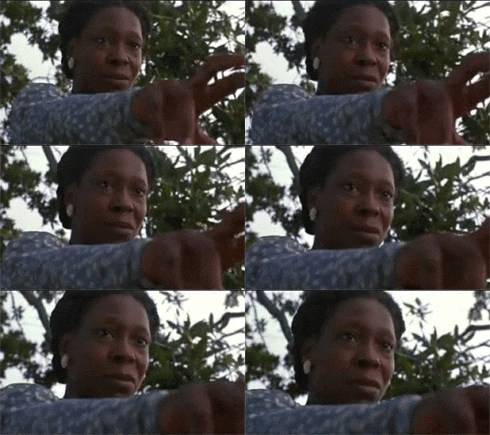
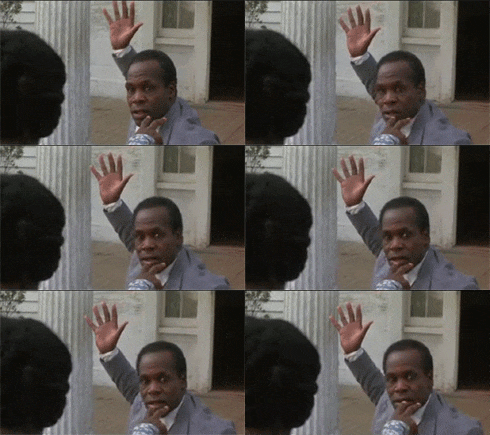
Finally, back to BET and the fact that most of us have seen this movie more than enough times to appreciate and acknowledge its cultural relevance. It had been a staple of BET Sunday afternoon programming (until Welcome Home Roscoe Jenkins replaced it). In fact, TCP has to be in the Top Five of the most quoted/memed Black movies of all time. I know this is a generalization but is there a Black person alive (older than 16) who doesn't recognize the context of Sophia or Shug Avery declaring "I'se married, I'se married now!"; or someone being pulled aside and asked, "Harpo, who dis?"; or this stern reply in a perfect Miss Millie intonation, "I don't know him"? You mean to tell me that you grew up on this movie, can quote lines from this movie, but still missed the point?

On this land??? (And if you caught that reference, then I KNOW your Grandmothers and Aunties would be ashamed if you are choosing the wrong side of this debate.) 

Now, if you read this far, there's not much more that I have to say...except (begrudgingly) you can dislike TCP for any number of reasons including, but not limited to its depiction of Black men. It is a good film, not perfect. Some of the critiques that have been offered are valid, particularly that director Steven Spielberg made certain creative choices that are problematic. And if you have paid any attention to Alice Walker over the years, she has become, shall we say Jim Brown-complicated--simultaneously wonderful for her past accomplishments and hideous the more we learn about her life and beliefs. I find her antisemitism and transphobia to be especially troubling. (Perhaps I could be accused of similarly attempting to bury the lede on Walker, but trust, I have and will revisit that can of worms another time.) As for the adaptation of the stage play for the silver screen, I must reserve judgment since I haven't seen the play (my parents did see it, and I am happy to report that it didn't provoke the same polarizing reaction). But still, just give it a chance as you should any other film. 

PS: Don't hate on Colman Domingo for being too believable as Mister if you haven't seen him in Zola (2021) (which I did and umm, yeah #IJS as a society, we need to be far more outraged by the way women are subjected to various kinds of abuse and exploitation)...

Friday, March 17, 2023

Angela Bassett: The Queen of Our Hearts

I waited a couple of days (and some change) to comment on this matter because understandably, folks have mixed feelings. We all want to believe that opportunities are apportioned accordingly, and that credit is given when and where it is due. We all want to believe that the sun is bright enough to shine on all of us. Therefore, I am not upset that Angela Bassett lost the Best Supporting Actress Oscar this year.

I said what I said.

I saw Wakanda Forever (2022) opening weekend. I have a piece in draft that I have been working on since last November that expresses some of how I felt about that movie and her stellar performance. It was great and worthy of the nomination.

I have not seen Everything Everywhere All At Once (2022) all the way through yet (keep missing the first hour), so I can't say if Jamie Lee Curtis was deserving of the hardware; therefore, I also cannot argue that her co-star Stephanie Hsu was more deserving. Instead, I can suggest that this was obviously a sentimental nod to Curtis, who has reached a certain stage in her career, thus very on-brand for Hollywood to honor her in this way. (But I know nobody really wants to hear that right now.)

However, and I hope that this can be an agreeable consolation, I fully expect that Bassett will get her Oscar. Not as a supporting actress mind you, but in the category that is most befitting of our Supreme Sister Auntie Queen. And on that glorious evening, my hope is that we will all look back on this current snub and humph in satisfaction that her triumph happened in due time and course, and not as some kind of consolation prize in response to an #OscarsSoWhite trending hashtag.

This year of our Lord 2023, the Oscar blessings went to badass Michelle Yeoh. And to the inspirational Ke Huy Quan. And to Brendan Fraser for wearing a fat suit. And yes, even to the Dean of the Scream Queens, Jamie Lee Curtis.

There may be reasons to believe that these were not the best choices, but those are debates for the critics and among the Academy members who saw each nominated performance. As we recently learned, we can't even guarantee that most of those voters actually saw all of the films. As to Jamie Lee Curtis, I say we dispense with the grumblings because this has to be the high-water mark of her career at this point. Yes, she's a veteran actress with famous parents and a considerable list of IMDb credits, but unlike some of her peers who have been nominated multiple times like Meryl Streep, Cate Blanchett, Frances McDormand, or Dame Judi Dench, the likelihood that Curtis will ever grace that stage to claim another statue is low. This is just one of those lucky flukes. 

No offense, but for someone who just released another Halloween movie in 2021, what else is there for her at this point, other than to portray someone eccentric and weird? Here you have a working actress who's been around for long enough not to be too jaded or too impressed by what she does for a living. If she even had to audition for this part, it would shock me, but for the sake of argument, let's assume she went in to read and when the casting director called her agent, their discussion went something like this: 
Casting director: You know what would be a hoot?
Agent: What? Jamie Lee trying her hand at martial arts? 
Casting director: Yes, but what if we had her look like a crazy cat lesbian who could perform martial arts?
Agent: Can we do that? And what if we put her in a bad wig and give her floppy hot dog fingers too?
Casting director: Sure, why not? Who will even notice?

And Curtis loved the idea because who would have noticed her as a supporting character in a quirky film like EEAAO for a sporadic 10-15 minutes worth of screen time? There is no way she expected any of this attention until the nomination came and suddenly the momentum behind the film took her like a wave. 

Furthermore, that is the entire point of honoring a Best Supporting Actor. S/he isn't the star--s/he's some random scene stealer who had an interesting/pivotal line or transitional moment. Either s/he died, killed, saved, or taunted the hero/ine: Louis Gossett, Jr. mocking Richard Gere as "Mayo-naise" while he slithers through the mud during basic training or a half-naked Anne Hathaway coiffed in a buzzcut and dying of tuberculosis. Everybody honored in that category enjoys their moment in the spotlight, then they disappear quietly to try their hand at something else like bee farming or Broadway.

That is not the career trajectory we should want for Angela Bassett. Quite honestly, it still doesn't sit well with me that Viola Davis got talked into submitting her name for that supporting category in 2017 because now it will take her another 20 years to ever get nominated again. We could have a whole debate over the value of an Oscar nomination as opposed to a win, and then more discussion about how it doesn't even benefit women as much as men in the grand scheme of things. We could engage in all manner of debate over the meaning of an Oscar versus the quality of roles in an actor's career. We could write these long think pieces about the snubs and slights and slaps, or...

We could write screenplays. We could write songs. We could compose music scores. We could design exquisite costumes and sets. We could be directors and producers. We could advocate for more opportunities for jobs in the industry. We could take notice of the fact that most of the people who win multiple Oscars are the folks who put in the work behind the scenes.

That isn't to say that our complaints that the #OscarsSoWhite weren't valid or that the improvements only lasted for a few award cycles. By drawing attention to the Academy's lack of diversity, changes did come. It came with everything, everywhere (all at once) from who got nominated to the kinds of projects that were greenlit. A Black woman was elected President of the Academy and we finally got a Black superhero movie with a Black director from the Blackest city on the West Coast. All of that set the stage for Ruth Carter to win two Oscars (and I bet no one even realized that she's been designing costumes since the 80s). Calling out Hollywood's highfalutin snooty predilections for English period dramas and biased historical fiction got them to broaden the categories to consider a wider range of films. 

This is why I say we shouldn't sweat this. We can't adopt the same mindset that excluded us by suggesting that a win for one person or community is a loss of opportunity for another marginalized community because it isn't. No, an Oscar isn't a participation trophy, but neither is an Olympic Gold medal or a Superbowl ring. Everybody isn't going to get one but it's a good thing when more people are allowed to compete on that level. And in that sense, everybody does win. For too long, that wasn't the case, not just for Black people but for every excluded group in Hollywood. There is a world of talent--a whole world, and we've barely scratched the surface.

A few months ago, I spent a Saturday afternoon watching Turner Classic Movies, and I got to see the musical Flower Drum Song (1961) with Miyoshi Umeki, the first East Asian American actress to win an Academy Award (Best Supporting Actress for Sayonara in 1958). By my math that was 65 years ago, and I had never heard of her despite the historic nature of that career accomplishment. It took decades to get to The Joy Luck Club (1993) amid the incremental progress of individual Asian actors. And then it still took years to get films like Mulan (1998), Crouching Tiger Hidden Dragon (2000), and Crazy Rich Asians (2018), so if Black people are complaining that #OscarsSoWhite...and Mickey Rooney's cameo in Breakfast at Tiffany's occurred three years after Umeki's win, then I don't think we're done complaining about the lack of diversity in Hollywood.

Not when we just find out that the first Asian actress to receive an Oscar nomination in 1936, Merle Oberon, was passing for white so there is a disclaimer to the description of Michelle Yeoh's historic nomination. Not when we just learned that there are other regions in India (Telugu) that produce energetic musicals other than Bollywood. Not when women are still overlooked as directors in spite of turning in excellent work.

Which brings me to the inevitable backlash from the disgruntled old Hollywood guard. We start with that anonymous Cowardly Lion quoted throughout this article, the critically acclaimed Actor. I wasted a lot of time thinking about who this person might be and how best to express my disdain for him in the most unflattering way possible. I settled on a caricature--some former teen heartthrob, pretentious Tesla-driving, recurring CSI guest, nepo baby. In other words, another limousine liberal who claims to be vegan but only because he chews his steak and then spits it out (I'm pretty sure the interviewee is not Sam Seder, but you have to admit this clip perfectly illustrates the jab). Whomever he is, I hope karma comes in the form of his being fired by Gina Prince-Bythewood "the lady director" on some really prestigious project because he failed to "sit [TF] down, shut up, and relax" as told, so he's replaced by Cate Blanchett, who then goes on to win her third Oscar. As for Paul Schrader, that sleepy old fart...

Finally, I have a few words for all of these body language experts on social media who seem to know what was going on in Angela Bassett's head when her name wasn't called for that Oscar. WTF? Are y'all just determined to make Black women the villain in everybody's origin story? She looked surprised and disappointed. Perhaps she assumed that if she was going to lose, it would have been to Stephanie Hsu or Kerry Condon. If you look at the pictures of her husband, Courtney B. Vance in the same moment, he's the one who's mad. He was hoping that an Oscar win would mean the kind of salary bump per project that would allow them to put their twins through college.

Instead, folks and I mean snarky assholes like Piers Morgan in particular, want to sell this narrative that Bassett should have appeared more gracious, as if others haven't had similar reactions to losing in the past. I vividly remember how the late Lauren Bacall looked absolutely pissed in 1997, and apparently that was not my imagination because she's included on this entire list of other disgruntled nominees. A really shitty and sore loser reaction would have been to storm off and leave like Morgan did here...but whatever snowflake.

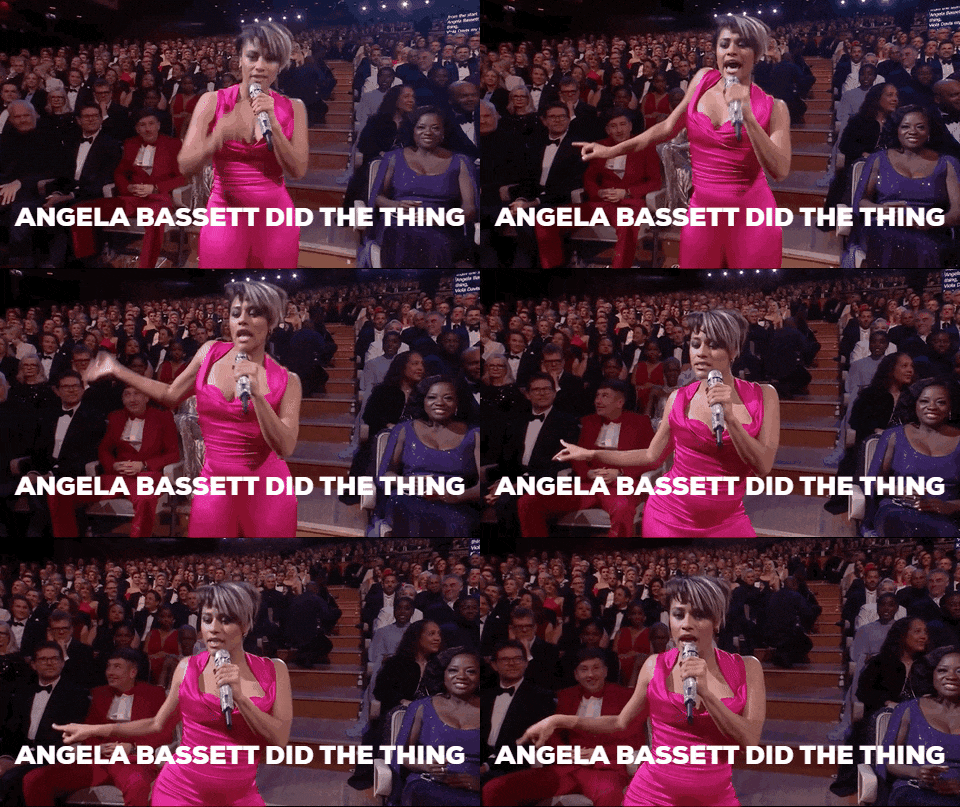
Dear Beloved Angela, you already know that I'm not here to urge you to take comfort in just being nominated because we're past that at this stage of your career. You did the thing, which was to carry the whole weight of that movie on your majestic shoulders in the wake of the incalculable loss of its fallen star. Notwithstanding the fact that some people couldn't appreciate that kind of fortitude, it remains my contention that your performance was too good for the Oscar in that category. And that isn't shade to the past winners, it is just stating facts. This was hardly your defining career moment.

So on your behalf, I have already declared and decreed that this won't be the last time you'll be nominated; if anything, this will be the last time anyone can make the claim that you aren't worthy of an Oscar. You've proven that time and again since 1992 when you were first nominated for portraying Tina Turner. This entire controversy is a distraction meant to rationalize why the Academy has been dragging its feet in acknowledging you and how they messed up the televised In Memoriam segment again. 

That's all I have to say. I'm pretty sure that Courtney, your kids, Austin Butler, and everyone else has bestowed you with flowers and all manner of consolation. Michael B. Jordan and Jonathan Majors already let the Academy know they messed up when they took to the stage. And in spite of these hit pieces written by the publicists of some other disgruntled actresses, we are confident that you remain unbothered and thoroughly unfazed. You and Jamie Lee Curtis will be photographed getting drinks and this will blow over. You know who you are, and so do we.

Saturday, November 19, 2022

Jangled Bells

It's the most annoying time of the year...

Yep, my inner Grinch is back because y'all insist on pushing Christmas on me earlier each year. This year, I swear some Southern radio station was playing Christmas music before Election Day and that isn't even the worst of it. I've been seeing Black Friday deals since September, so yes, it is already way too much too soon. 

Give folks time to eat the rest of the Halloween candy, damn!

Regular readers of this blog already know to expect a lot of bah humbugging from me right around this time of year, so no new ground to cover by writing yet another piece about how much I hate Christmas. So let's go in a different direction by addressing one of the many reasons why I find all of this so ridiculous: Christmas movies.

Specifically, the Hallmark kind that always end with a happy couple kissing in a faux snow-covered gazebo. Or the kind that features a magical appearance by Santa or his wife or an elf or an angel or an abandoned baby or a ghost. I think that covers the gamut of plot possibilities because no one has come up with a new Christmas story so y'all just do a remix of the various themes already out in the universe. And while there are a few Christmas movies that I do enjoy and could watch over and over, those tend to break the formulaic mode because they are comedies or about family dysfunction. If there is an all-day marathon of A Christmas Story (1983), Elf (2003), or The Family Stone (2005) playing somewhere, I am there--just not until after my birthday.

Every year, Hallmark, Lifetime, and now TVOne roll out a new batch of Christmas movies which makes avoiding that aspect of the holiday just as challenging as escaping Mariah Carey's All I Want for Christmas. I'm pretty sure that other TV networks have taken note and have been working on their own holiday programming, so now might be a good time for me to finally pay for a streaming service. What are the kids binge-watching on Hulu these days?

Having said all of that, the real reason I've brought you here today is to take note of a little article I recently read that explains why one of Hallmark's biggest movie stars, Candace Cameron Bure, suddenly defected to Great American Family network. Now, when this was initially announced back in April, I took a moment and thought, hmm, I guess that means more work for Holly Robinson Peete. And then I realized, yeah it must be nice that Candace can take her toys to her own room so that she won't have to share.

If you can read between the lines, it seems rather convenient that Bure would claim to want to promote more family-friendly holiday fare now that Hallmark has opted to expand the definition of its family offerings to be more inclusive. Not just in terms of racial diversity, but in presenting representations of family that depart from the "traditional" nuclear model. And while that is certainly her right, nothing screams I'M A SANCTIMONIOUS KAREN louder (except maybe writing it in all caps like I just did).

Color me not at all surprised because this script is just as predictable as one of those holiday movies. The former child star had built quite the brand for herself as the face of Hallmark made-for-TV movies. She got to work for about three to four intense months, and then spent the rest of the year teaching Sunday School and baking bread. It was the perfect gig, but then we had to ruin it for her by asking why come she and her other sitcom sorority sisters were the only ones getting cast in those kinds of movies. And then suddenly it was inconsistent with her brand to be seen in the company of the very people she moved to the exurbs to avoid in the grocery store.

I had taken note some time ago that the offerings on Hallmark were very pumpkin spice latte, so I rarely watched anything on that channel other than The Golden Girls or Fraiser reruns. Since I always fall asleep with the TV on, I often woke up to I Love Lucy, which as many of you know is definitely an all-time Busy Black Woman favorite. Like many niche channels, Hallmark fills the spaces between shows with a lot of promos for its own programming. And I began to detect a theme...

I wanted to keep an open mind about what or who I rarely saw. But it was kind of obvious, and despite the appearance of an occasional Black or Asian best friend, some things are exactly what we see as clear as day. Perhaps it could be written off as unintentional that Hallmark had become a refuge for former sitcom actresses, all of whom happened to be white...or maybe it was a choice. Because I could think of several nonwhite sitcom actresses who certainly could use some work but don't ever seem to get any.

The lack of diversity became undeniable to me the Christmas the Hub and I stayed with his sister. I remember that holiday in vivid detail because she LOVES those movies, they were airing 24/7, and I was pregnant. For three days (talk about biblical allusions), I don't know how many of those movies I sat through and actually watched, but if you can believe it, one stood out from the milquetoast fare. It starred Lacey Chabert, whom I knew as the kiss-ass friend from Mean Girls (2004), as a woman who gets wooed by a Prince in A Royal Christmas (2014). I don't remember anything distinct about the love interest, such as how they met or fell in love, but I do remember that his mother was Doctor Quinn Jane Seymour herself. And I thought out loud, well is there a white actress who hasn't been cast in one of these movies yet? When will there be movie starring the daughter from Mr. Belvedere?

No response to my pregnant rantings, so I just sat quietly in my corner. I could either brave the Staten Island Mall two days before Christmas, read one of my SIL's cookbooks, or give in to see if there was anything compelling or redeeming about any of these movies. I choose option C, and while not entirely terrible, it was a lot like spending a sick day at home with my grandmother. In other words, I knew to expect a bowl of canned chicken noodle soup, some saltine crackers, and an intense stare-down with Victor Newman...

The fact that my Nuyorican SIL was unfazed by the predictability of the plots or the homogeneity of the casts, in addition to knowing many sistahs who enjoyed those same movies, it made me wonder why none of the upstart Black cable networks hadn't produced any of their own holiday fare. It wouldn't have meant sacrificing much time on their already packed programming schedule to preempt a few hours of Martin reruns or not to air The Color Purple (1986) one weekend. Who would notice if instead of Danica McKellar, we got Tempest Bledsoe some work for a change? 

Like every other good idea that I was too busy to put into action, someone at TVOne realized that this ain't rocket science. Since practically every Black sitcom had a very special Christmas episode in the vaults that had been inspired by It's a Wonderful Life (1946) or Charles Dickens' A Christmas Carol, how hard could it be to come up with something, anything other than the sugar cookie cut-outs on the Hallmark channel? I don't know if Merry Wishmas (2018) was the first of their original movie offerings, but they've been pumping out new holiday movies every year which must have caught the attention of the Hallmark suits. Because now they've responded with their own Mahogany line of Christmas movies, along with a VIDA lineup, and methinks that it was only a matter of time before someone pitched the idea of two elderly lesbians kissing under a gazebo covered in faux-snow. And that was just too much for the most wholesome and ever self-righteous Candace Cameron Bure.

That, and having to cede some of her realm to Holly Robinson Peete.

I'm not calling Bure any names, just pointing out that it is really convenient to allude to "traditional family values" as a euphemism for realizing that she was no longer the Queen of the Hallmark Movie Empire. I wouldn't go so far as to call her a bigot; instead, I would argue that this was a rather shrewd move to make in the midst of a white-hot culture war raging in the real world. In a year when there has been legislation introduced in several states that target trans-youth and claims that children are being indoctrinated into the "gay lifestyle" by a storybook about two penguins, yeah Candy Girl you definitely chose a side. And again, that is your right, because there is an audience that prefers to only see stories that reflect what makes them comfortable in their own biases, so go forth and be mediocre!

But please do me a favor and stop using your narrow definition of Christianity as justification for your intolerance. I'm a Christian too Boo, and my Jesus, the one whose birth your crap ass movies are supposed to celebrate, doesn't seem like the kind of person who would have been concerned about tarnishing your brand. He wasn't all that worried about being seen with the wrong kind of people because there was no such thing in His eyes. You don't have to take my word for it because He said so, and I urge you to look it up in one of those $65 bibles you are hawking.

I will come right out and say it: the Hallmark channel got too ghetto for Bure, so she clutched her purse and hurried across the street. By switching to the Great American Family channel, she can lure her fans to the new mall where there is a traditional Santa and no David Sedaris-ian elves. At her new mall, Bure can get her overpriced coffee served in a disposable cup that has CHRISTMAS emblazoned all over it, brewed by an un-unionized underpaid barista working overtime. Her brother's crappy Christmas movie can play in the multiplex and her tee shirts can be purchased in stores where the retail workers are required to wish you a "Merry Christmas" instead of Happy Holidays (because Hanukkah and Diwali aren't for real Americans). The new mall is everything the old mall used to be before everyone got woke...

Because isn't that the reason for the season--for folks to keep buying the illusion that the Cameron siblings have been selling all these years? They want top shelf placement for their stuff, not to be comingled in what they perceive to be the bargain bin with ours. God forbid that someone just might prefer The Drifter's 1954 version of White Christmas to the movie version from White Christmas the film, also released in 1954. And why not add a little José Feliciano in the mix because Feliz Navidad is a jam! The notion that there is only one right way to celebrate Christmas, or that this is about constraining Christianity when it is all about Capitalism is absolutely on-brand for both Candace and Kirk and their ilk--former child stars whose careers were built on nostalgia for realities that only ever applied to them.

I want to end this on a more festive note because Bure did a lot of people a big favor by making such a dramatic exit. As she stated, this gives her an opportunity to help launch a new venture from the ground floor, so that is both admirable and risky. And by leaving an already established network franchise, she has cleared the stage for other actresses to get some of that Hallmark holiday shimmer and shine. Let the Mowry sisters build themselves an empire! My issue was never about the fact that she left (because even though I did write an entire piece on the matter as if I care, I don't); it is with the manner in which her departure was framed, as if she had to run for her life in order to save her virtue.

Although I'm sure her movies won't get any better on a different network, at least she is safe from secularism and the gay agenda. Her values and her fortune secured, Candace Cameron Bure will be just fine. All of you avid Christmas rom-com movie fans now have an additional channel with a new slate of movies, so now I know what to avoid while channel surfing. 


Tuesday, December 28, 2021

Feeling Secure

Twas the day after the Christmas and I spent the afternoon on the sofa with a bottle of sparkling wine, chicken strips, and a few hours of kid-free silence. So naturally, I did what every other Insecure fan should have been doing in preparation for the series finale later that evening--I caught up on the episodes that had I missed or half-watched from this last season.

Now, because I am mindful that there are Busy Black folks out there who aren't fans or maybe haven't had a chance to watch the finale, so I won't spend that much time this Monday quarterbacking the finale. Watch it, come to your own conclusions, and then come back here for my take on what I hope will be the impact of Insecure for the long-term.

1. Conversations with our families about estate planning - This really hit home for me. My parents wrote their wills some twenty years ago, long before there was a notion of the chronic health issues we have faced for the past ten. My Mom, on the sage advice of Suzie Orman, had the foresight to invest in long term care insurance, which has made been a lifesaver in every possible way. While my Dad is still old school with respect to his faith in life insurance and bank savings, it was the financial planning that my Mom initiated that has really made this season of their lives manageable for us as their children.

There's so much more to say on this topic, because Black people can be inconsistent when it comes to death. On the one hand, we deal with it as a part of life, yet it amazes me just how reluctant our families are to plan for anything other than the funeral. I don't want to think about dying either, but if these last two years have taught us anything, it is that we need to have contingencies in place to deal with the unexpected. TALK TO YOUR PARENTS! Get their passwords. Have them walk you through their finances. Ask them how they want things to be settled. And talk to your siblings so that everyone is on the same page. Ain't nothing worse than drama and tension on the front pew that never gets resolved. 

2. Embracing imperfection by dropping the Black superwoman trope - The name of the show was Insecure. A lot of y'all missed that. Some of you were very critical that Issa didn't have her shit together from the beginning. Some of you probably thought highly of Molly until she realized how much of a hot ass mess she had been for four seasons. Some of you were more concerned about Tiffany wearing your sorority colors than you were about the vulnerability she showed as a new mother suffering with post-partum depression. You might have missed the fact that Kelli was sober this entire season, which was a good thing considering that she pissed her pants during Coachella and got into all kinds of nonsense whenever she imbibed. Y'all were siding with Lawrence's irresponsible fuckboi declaration that Condola blew up his life when she got pregnant (which we're going to revisit a little later).

Life is messy and not even fictional people are perfect. Thank goodness!

3. Addressing the stigma of mental health, especially among Black men - We saw Molly with a therapist, and I know that the religulous among you will argue that all she needed was Jesus. But I'm sure He would have sent her to a therapist too. Despite the ultimate outcome of his story arc, Nathan was one of the most valuable characters, working through his issues with others and with himself. Unlike most stereotypical depictions of mental illness (the homeless vagrant or the drug addicted loser), it was refreshing to see a high functioning, yet flawed individual who owned his issues. 

4. Establishing and maintaining mature co-parenting relationships - So we've reached the hill where I plant my flag--Lawrence, the dude who perpetually let life happen to him finally grew a pair! The fact that it took his fast-talking friend Chad to blurt that out at him for it to finally sink in that he needed to make some choices and man the fuck up (and you thought that was only about his on-and-off again situationship with Issa)...

And one of those choices was to be more present in the life of his son with Condola. She didn't get pregnant--they were fucking. Birth control goes both ways, but sometimes it fails and one of those little swimmers is gonna go all the way (we all saw Look Who's Talking). Given that Lawrence was rather promiscuous generous, I'm surprised that he hadn't created more babies...but y'all aren't ready for that conversation.

Instead, let's keep the focus on the fact that if more folks took responsibility for their actions, the world would be so much better for the children that result. I say that as a lawyer who used to represent parents in their custody disputes. I say that as a woman who has read some of the really shitty takes that some weekend Dads have expressed about paying child support. I say that as a mother with equal disdain for the toxic Moms who feel entitled to erect insurmountable barriers to healthy co-parenting because they have irrational trust and control issues. 

Look, parenting is hard within a marriage, let alone between two households. We only got one full episode, a HUGE blow-up, and a few tranquil scenes scattered among subsequent episodes, but I assure you, it took a LOT of work to get him to that happy ending. 

5. Blackness is Beautiful - I mean, we know this but I don't think the rest of the world always gets to see it presented that way. Sure, we've had sitcoms with all-Black casts that have been unapologetically Black in the past, but this time we got an experience that showcased Black Los Angeles as well. We saw Black people at art galleries, at outdoor festivals, planning events, attending Coachella, hiking, hanging out on the beach, owning businesses, and doing all of the bougie stuff that white folks assume we don't do. We drink coffee too, but in every other sitcom, we'd be the sassy barista or the silent busboy. In any other sitcom, we'd see a few Black faces in the crowd and that would be touted as inclusion. For once, it was great to see us as the foreground and the background. It was significant to depict various aspects of Black life that weren't confined to any one space within the community--the Dunes apartment complex in Inglewood was just as integral as Molly's downtown office or Crenshawn's warehouse workspace or Black alumni weekend at Stanford.

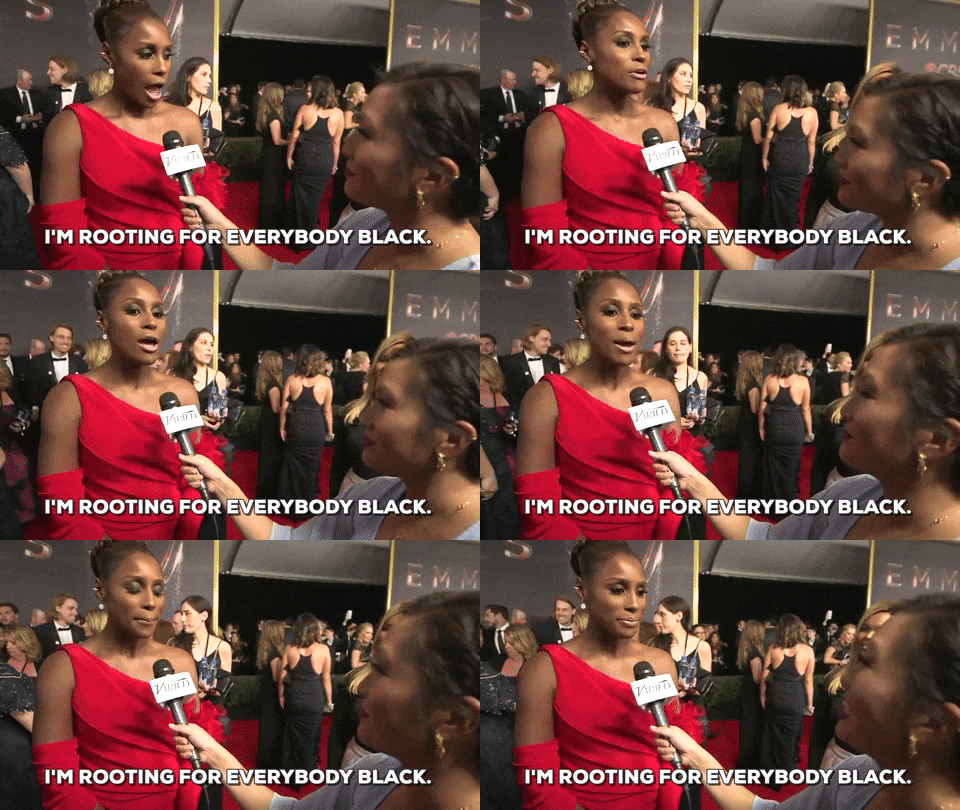
It matters that Issa Rae, the actress, writer, and producer was an aspirant just ten years ago when we first encountered Misadventures of Awkward Black Girl back in 2011 on YouTube. Like most people who became fans of that effort, who could have foreseen that it would lead Rae to the point where she is today? Not just in her career, but also the other Black actors, writers, and directors that she took along with her for the ride: Stella Meghie, Melina Matsoukas, Prentice Penny, Natasha Rothwell, Jay Ellis, and Yvonne Orji. I am thinking about Tracy Oliver, the antagonist on the web series, who is now a budding media mogul in her own right. There is also Robin Thede, the writer and producer of the hilariously funny and Emmy-nominated A Black Lady Sketch Show. I am thinking that when Rae stated that she was rooting for everyone Black, that meant EVERYBODY.

Of course, the predictable backlash to this will be to point out that there is no such place as Black LA if we only make up 8% of that city's population. Some snooty TV executive, probably the same guy that canceled Girlfriends without a series finale, will wonder aloud where in Los Angeles they found that many Black people and whether it was truly representative if there were not as many Latinx or Asian Americans depicted (because it is perfectly acceptable to accuse us of excluding others). Surely, token efforts to integrate shows like the original Sex and the City or Girls, which celebrated a very specific demographic of empowered white woman (the Christines and Kristins) would have more impact. Just greenlight a reboot or a pre-boot with a Black girlfriend and set one of the episodes outside of their typical exclusive enclaves of privilege. Send Miranda Hobbs to a Black church in Harlem with her law school professor. Because that isn't racist...

But it ain't progress either.

I would love for the legacy of Insecure to be a more sustained movement towards inclusion in Hollywood--more diversity in directors, writers, production crews, etc. It would be great, but I lived through the 80s and 90s. Ground-breaking popular Black shows still get marginalized while mediocre mainstream shows live on in syndication. I still believe that our stories deserve to be told and that there is plenty of space on the red carpet for more diversity, but I don't want to wait another 30 years just to make incremental advances. Because Issa Rae decided not to rest on her dreams, someone else needs to wake up and follow suit. 

Are you waiting on a chance, or are you taking any?

Read that again, look at the calendar, and get then serious about making that next move. If you saw the finale, that was a personal message in a bottle that even if the ground is shaking beneath your feet, trust yourself...Everything is going to be, Okay?!